Comparison with RADEX
RADEX (van der Tak et al., 2007) is a popular algorithm that solves radiative transfer for given column density, H₂ number density, and gas temperature. Comparison of RADEX with 3D-PDR and RT-tool is only valid for:
Isothermal runs (thermal balance switched off)
Uniform-density 1D clouds
No external radiation field
3D-PDR Setup for Comparison:
Edit
config.mk: setGUESS_TEMP=0andTHERMALBALANCE=0for 1D runsModify
params.datas appropriate. For instance:2) 1Dn43.dat !ICs file -- assuming you have already created it ... 4) radexcomp !Output prefix 5) 0 !G0 (no FUV) 6) 1.0E-17 !Cosmic-ray rate ... 9) 1.0 !Turbulent velocity ... 23) 30.0 !Gas temperature ... 33) hco+.dat !HCO+ coolant -- e.g. if you want to include additional coolants
Run
./3DPDR
RT-tool Setup for Comparison:
Edit
paramsRT.dataccordinglyRun
./RTtool
RADEX Setup for Comparison:
Set the linewidth value to that of turbulent velocity used in 3D-PDR and RT-tool
Set the RADEX “escape probability” to
LVGfor consistency.Use as H2 number density and column density of the coolant, the values outputted by RT-tool.
Note
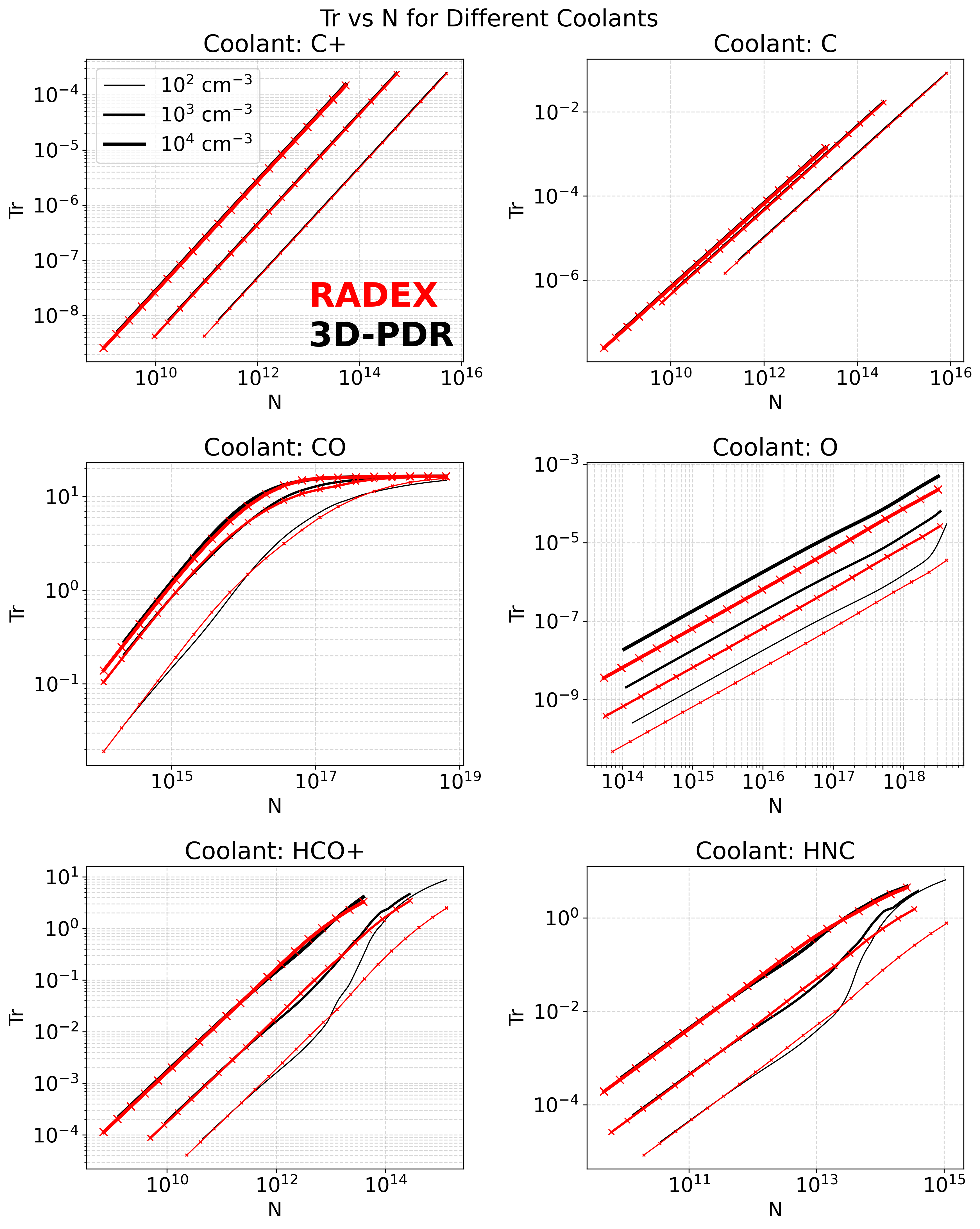
Differences are expected since 3D-PDR treats the cloud as 1D with depth-dependent level populations, while RADEX uses a 0D approach.
Example
The plot below shows a comparison between 3D-PDR & RT-tool (black lines) against RADEX (red lines). The comparison is done for three different uniform density models with \(10^2\), \(10^3\), and \(10^4\) total H-nucleus number densities at a fixed gas temperature of \(T_{\rm gas}=20\,{\rm K}\). The radiation temperatures (Tr in K) of C+, [CI] (1-0), CO (1-0), [OI] 63μm, HCO+ (1-0) and HNC (1-0) versus the column density (N) of the corresponding coolant are shown. In general there is a broad agreement between the two codes. As noted above, the differences seen in e.g. HCO+ and HNC for low densities are potentially associated with differences in the treatment of level populations.